
A client questions recent portfolio performance during market volatility
When building multi-asset portfolios, much of the focus is on choosing investments, managing risk, and optimizing returns. But a strong portfolio starts with a clear investment philosophy.
That’s why the Sun Life Global Investments Portfolio Construction & Investment Strategy Team developed its Philosophy-to-Growth Framework. It shows how a thoughtful investment philosophy can help guide portfolio construction, strengthen client relationships and support long-term practice value.
Philosophy-to-Growth Framework
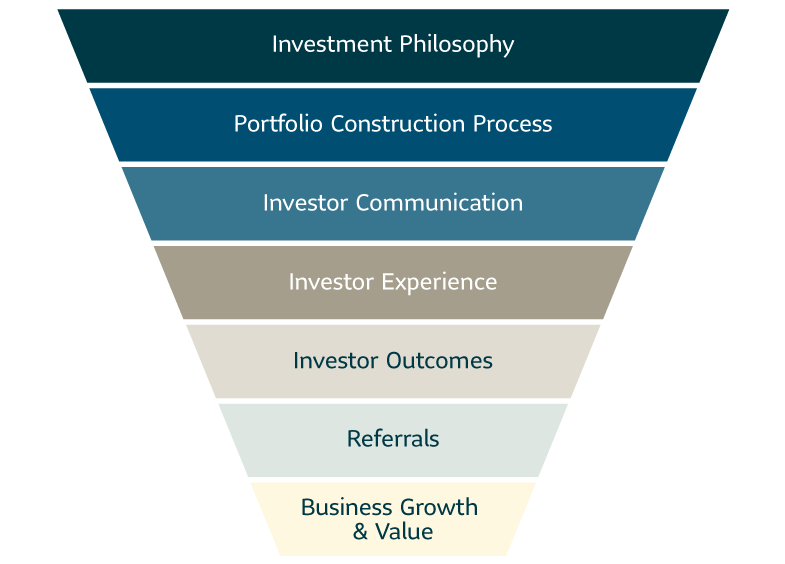
Investment philosophy: The foundation of your portfolio construction process
An investment philosophy defines an advisor’s core beliefs and values about how markets work, where returns come from, and which risks are worth taking. This foundation is critical as it shapes every downstream portfolio decision.
A strong investment philosophy helps answer several key portfolio construction questions, like:
- What drives long-term investment returns?
- What does diversification mean and how should it be implemented?
- What role should active vs. passive management play?
- How should portfolios behave during periods of market stress?
- How do we define risk?
Using your investment philosophy as a communication tool
Clients are not simply buying a portfolio; they are buying a disciplined investment process. Because advisory services are somewhat intangible, clearly communicating their process is a critical part of an advisor’s value proposition. When advisors can define and articulate their investment philosophy, client conversations can shift from short-term performance to long-term discipline.
Did you know? Research suggests that the pain of financial loss can outweigh the satisfaction of comparable gains.* Clients who understand the rationale behind their portfolio’s construction may be less likely to abandon their investment plans during periods of market stress.
Consistently reinforcing a clear investment philosophy across business touchpoints helps clients understand and adopt your investment language. Over time, they can become better equipped to explain what makes their advisor different and how their portfolio is working for them - an important advantage in a market where advisory services can be difficult to distinguish. Clients who can clearly describe both what their advisor does and the philosophy behind it can become credible advocates for the advisor’s brand and a valuable source of referrals.
Consider this scenario
1. The scenario
2. The opportunity
The advisor uses a documented Investment Philosophy to explain portfolio positioning and long-term discipline
3. The outcome
The conversation stays focused on long-term objectives and reinforces investor confidence
Common investment philosophies
Investment philosophies can take different forms, but each provides a consistent lens for making asset allocation and manager-selection decisions. The examples below illustrate three common approaches.
Strategic Asset Allocation
Long-term diversification across asset classes is the primary driver of returns.
Factor Investing
Systematic exposures to factors like value, momentum, quality and low volatility are intended to improve long-term risk-adjusted returns.
Active Management
Skilled managers can exploit market inefficiencies and generate alpha.
Ultimately, an investment philosophy serves as the bridge between portfolio construction and client confidence. It provides the intellectual foundation for investment decisions and a clear narrative that can help clients navigate the emotional ups and downs of market cycles.
Written by the Portfolio Construction and Investment Strategy Team

Badan Fong, CFA
Portfolio Manager and Wealth Portfolio Strategist

Mathieu Pace, CFA
Senior Analyst
Let's do it together.
The Portfolio Construction & Investment Strategy Team helps advisors connect investment philosophy to client outcomes.
To learn more, please contact our Wealth Sales Team at 1-877-837-7844.
*Source:
- Kahneman, D., & Tversky, A. (1979). Prospect Theory: An Analysis of Decision under Risk. Econometrica.
- Tversky, A., & Kahneman, D. (1991). Loss Aversion in Riskless Choice: A Reference-Dependent Model. The Quarterly Journal of Economics.
FOR ADVISOR USE ONLY.
Service provided by the Sun Life Global Investments Portfolio Construction and Investment Strategy Team are exclusive to financial advisors and are not available to individual investors.
Information in the reports produced by the Portfolio Construction and Investment Strategy Team should not be considered an indication of trading intent of any mutual funds managed by SLGI Asset Management Inc. and are not a recommendation to buy or sell any security. SLGI Asset Management Inc. does not manage the portfolios depicted in the reports produced by the Portfolio Analyzer for individual investors.