Expect mail delivery delays due to the Canada Post labour dispute. Sign in or use our app to access your account. Get help here

Understanding Total Cost Reporting

New Total Cost Reporting (TCR) is here to help investors better understand what they pay for, and the value they receive when investing in mutual funds, ETFs and segregated funds.


What is Total Cost Reporting (TCR)?

TCR is a regulatory requirement introduced by the Canadian Securities Administrators (CSA), the Canadian Council of Insurance Regulators (CCIR), Canadian Investment Regulatory Organization, Financial Services Regulatory Authority of Ontario and Autorite des Marches Financiers to improve transparency around the cost of investing.

The following solutions are included for TCR reporting: 

Starting early in 2027, the Annual Report on Charges and Other Compensation (ARCC) and annual statements for segregated funds for the 2026 calendar year will include additional information detailing the embedded costs associated with owning these investment products. This will include a dollar-based breakdown of investors’ ongoing costs. It includes the management fees and operating expenses to the fund company as well as the fee paid to your advisor’s dealer, which includes the compensation paid to your advisor. These fees are generally deducted from the value of the investment rather than paid directly by investors.

The goal of TCR is to show investors the full picture of owning these investments so they can better understand what they’re paying for and the value they receive.  Additionally, transparency is increased on the understanding of costs and to allow investors to better compare investment products based on consistent information.


How TCR affects investors

Knowing how much investments cost helps investors make smarter financial choices. But cost isn’t everything. Like with contractors, auto service and dentists the lowest priced option isn’t always the best one. Lowest price may not always mean the best value representing an opportunity for advisors to demonstrate the value they provide.

The Annual Report on Charges and Other Compensation will show:

  • The total fund costs associated with owning certain investments [The fund expense ratio: Fund management expenses (MER) + Trading costs (TER)]
  • The amount paid to dealers for their services, including advice (Account fee)
  • A total annual cost figure, expressed in dollars.

These costs were always part of investing – now they’ll be easier for investors to see and understand.


Breaking down investment costs – mutual funds

Total cost explained:

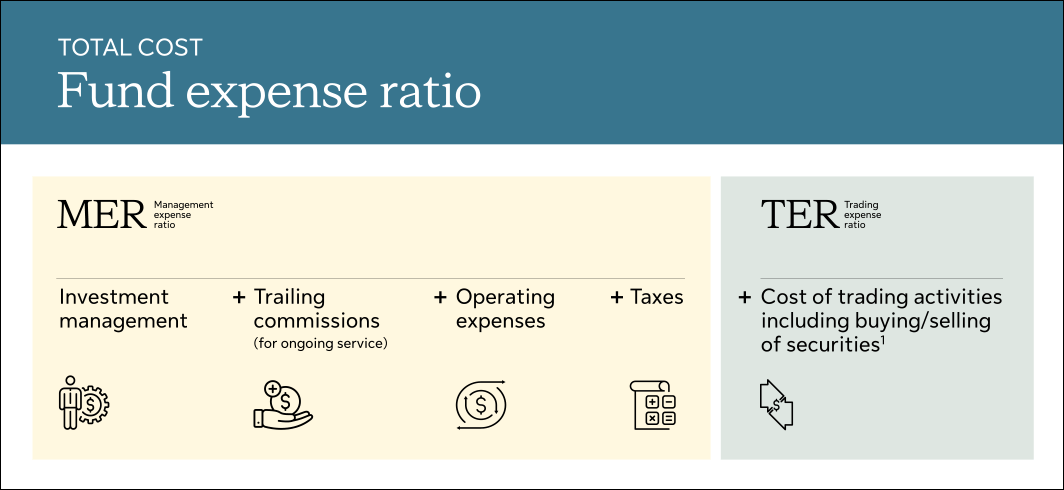
Fund Expense Ratio (FER) = Management Expense Ratio (MER) + Trading Expense Ratio (TER)

Total cost explained (Series A example): Fund Expense Ratio (FER) = Management Expense Ratio (MER) + Trading Expense Ratio (TER)

1Only for funds that hold equity securities.  These costs vary year by year.

Example: XYZ Fund Series A

Investment management fee   Trailing commissions   Operating expenses   Taxes   TER
0.65 + 1.00 + 0.20 + 0.21 + 0.03
= Total Cost: 2.09%

If the total investment is $100,000 then the cost annualized in $ terms would be $100,000 x 2.09% = $2,090 which is deducted from the value of the investment.

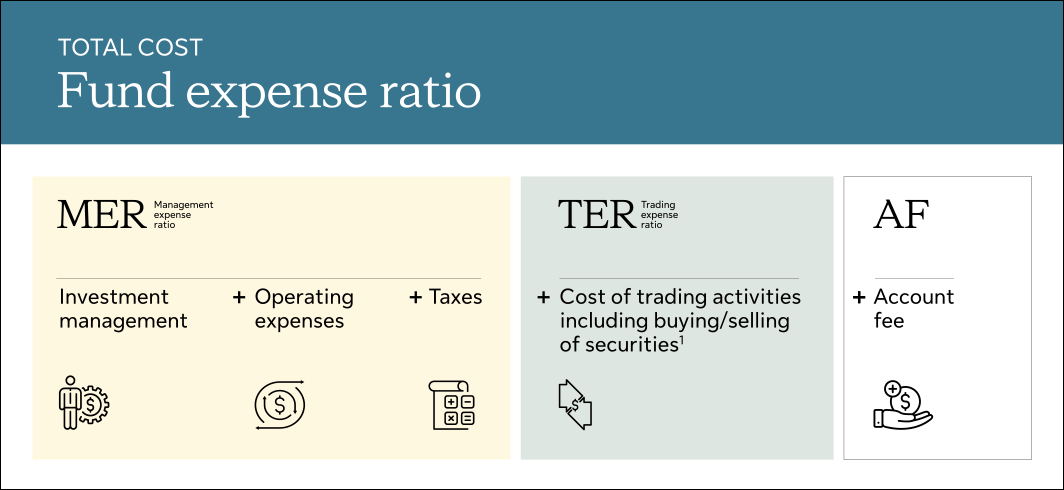
Total cost explained (Series F exmaple): Fund Expense Ratio (FER) = Management Expense Ratio (MER) + Trading Expense Ratio (TER) + Account fee
1Only for funds that hold equity securities.  These costs vary year by year.

Example: XYZ Fund Series F

Investment management fee   Trailing commissions*   Operating expenses   Taxes   TER
0.65 + 0.00 + 0.15 + 0.09 + 0.03
+ Account fee (can range depending on assets with advisor – assume for this example 0.75%)
Total Cost = 0.92% + Account fee 0.75%
Total Cost = 1.67%

If the total investment is $100,000, then the annualized cost in $ terms would be $100,000 x 1.67% = $1,670.  $920 would be deducted from the value of your investment and $750 would be paid by the investor to the dealer firm, where the advisor works.

*Please note that Series F does not pay a trailing commission and an account (advice) fee is agreed to by the investor and their advisor and charged separately – this amount will be included in the ARCC.

The key costs explained

Term Description

Investment management

(part of overall management fee)

Pays for:

  • Investment management services, with daily monitoring
  • Investment research, market data, and other important information
  • Fund oversight, service support and operational administration

Trailing commissions

(Series A)

(part of overall management fee for ongoing services) 

Fund companies pay ongoing fees called trailing commissions to the dealer firm where an advisor works. A portion of the trailing commission may be paid by the dealer firm to its advisors. The fund company pays this ongoing commission for as long as the investor owns the investment.

Financial Advice – see the value financial advice can bring to portfolios

Advisors may provide investors with various services such as:

  • Help to set and review financial goals
  • Investment selection guidance
  • Retirement planning
  • Budgeting
  • Insight into the markets
  • Portfolio rebalancing
  • Performance updates

Account fee

(Series F)

An account fee is a direct charge, often a percentage of the assets in an investors account (assets under management), paid to the advisor or firm for their financial advice and service. Unlike commission-based accounts, which charge for each transaction, fee-based accounts charge a recurring fee, typically monthly or quarterly, to align the advisor's interests with the client's goal of growing their portfolio. 

Operating expenses

Each fund pays operating expenses that pay for day-to-day expenses. Services include auditing, accounting and fund valuation, record-keeping, custody, filing and legal matters.

Taxes1

Each fund is required to pay taxes on the management fee, insurance fee and operating expenses. Segregated and mutual funds calculate a blended GST/HST tax rate that takes into consideration the GST/HST tax rates for all investors based on the province they live in.


1Taxes apply to each fee component

Term Description

Trading activity

Trading costs are incurred by the fund when the portfolio manager buys or sells equities and can vary significantly from fund to fund and from year to year. Market conditions, investment strategy and asset class are a few examples of circumstances that may lead a portfolio manager to trade a security.

Fund asset mix

Trading costs are only incurred on equities, not fixed income (bond) securities. As a result, bond funds do not have a TER as commissions are embedded in a bond’s spread. Balanced funds will generally have a lower TER than equity funds.

Fund flows

The larger the fund’s inflows/outflows due to unit purchases or redemptions, the higher the TER. When portfolio managers receive new assets to manage, they must buy securities, and when unitholders redeem holdings, the portfolio managers must sell securities thus incurring trading costs.

Liquidity


Liquidity is how quickly and easily an investment can be converted into cash without a significant change in its value. Liquid assets, like cash or publicly traded stocks, can be sold easily and at their current market price. In contrast, illiquid investments, such as real estate or private company shares, are harder and slower to sell, potentially leading to a loss of value if needed fast.

Less liquid securities can be more expensive to trade than more liquid ones.

Trading desk

Access trading desk relationships that can help reduce the total amount of trading commissions paid by a fund.

Why choose Sun Life Global Investments

At Sun Life Global Investments, we believe clarity builds confidence. Our goal is to empower advisors with investment solutions – and information – that can be trusted.


Want to learn more? Download our brochures:

Information contained in this article is provided for information purposes only and is not intended to provide specific financial, tax, insurance, investment, legal or accounting advice and should not be relied upon in that regard and does not constitute a specific offer to buy and/or sell securities. 

Information contained in this article has been compiled from sources believed to be reliable, but no representation or warranty, express or implied, is made with respect to its timeliness or accuracy. This article may contain forward-looking statements. Forward-looking statements are speculative in nature and cannot be relied upon. Forward-looking statements involve inherent risks and uncertainties about general economic factors, so it is possible that predictions, forecasts, projections and other forward-looking statements will not be achieved. You are cautioned to not place undue reliance on these statements as a number of important factors could cause actual events or results to differ materially from those expressed or implied in any forward-looking statement. Before making any investment decisions, you are encouraged consider these and other factors carefully.