
Beyond low volatility: What is the Blended Research approach?
Explaining the unique process used in the SLGI MFS Blended Research Low Volatility Funds.*

Low-volatility investments tend to be thought of only as strategies designed to help reduce risk during market downturns. This raises the questions: should investors incorporate these funds in their portfolio when markets are strong? Are there any potential trade-offs they may face during strong market conditions?
Many low-volatility strategies share similar biases—such as favouring specific sectors or styles and avoiding others—which can lead to performance patterns that may not align with investor expectations. It’s also important for investors to understand that these strategies don’t always perform as expected and don’t all employ the same processes.
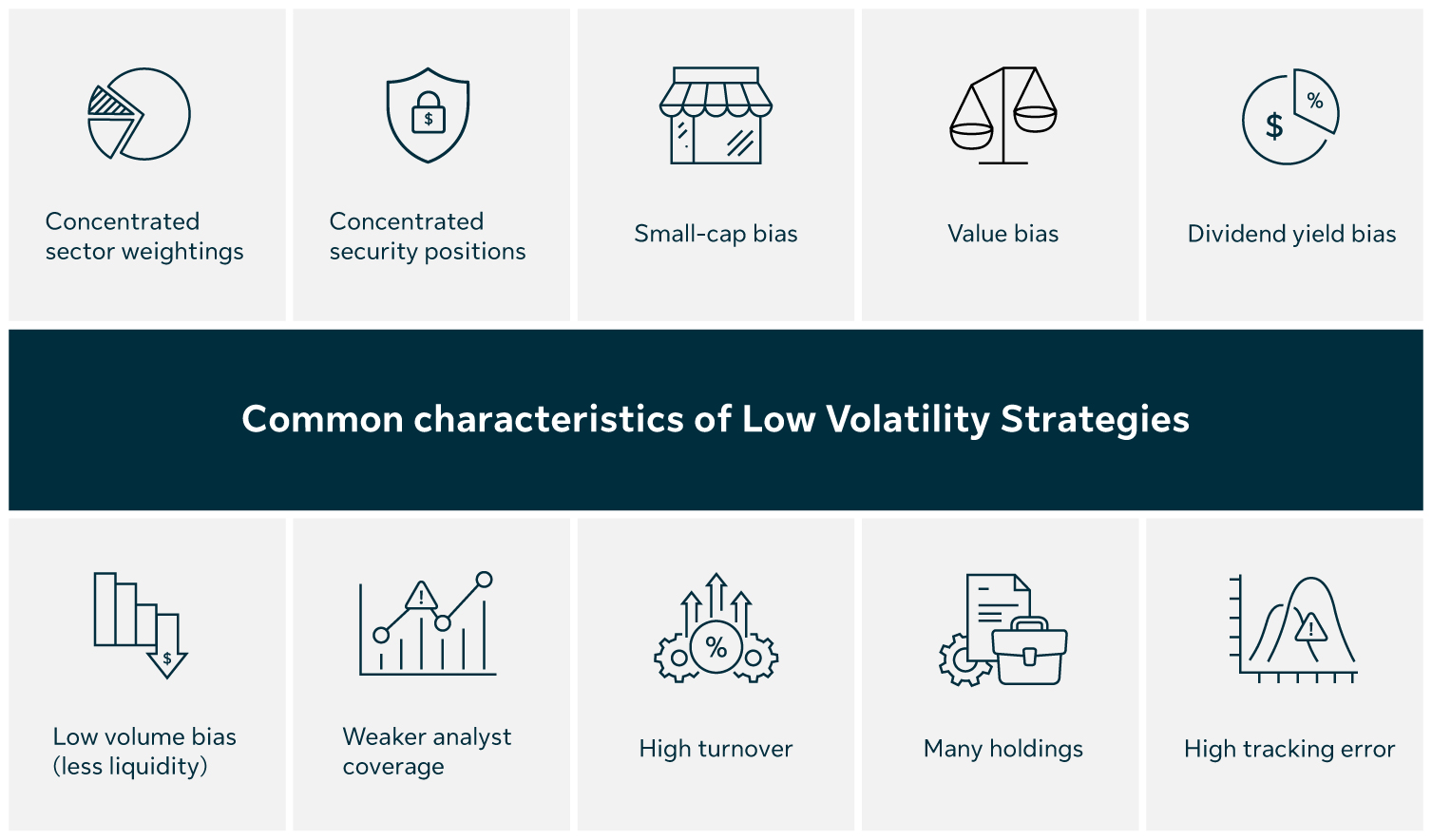
A portfolio consideration for whatever market road you drive through
Sun Life Global Investments brings MFS Investment Management's (MFS) Blended Research approach to low volatility investing within the SLGI MFS Blended Research Low Volatility Funds. This approach stands out from other low volatility strategies. It aims to protect investments when markets are down, while also capturing growth opportunities when markets are up. This can make these funds a valuable part of a well-rounded investment portfolio.
MFS Investment Management, sub-advisor to the SLGI MFS Blended Research Low Volatility Funds, carefully constructs portfolios using a combination of research approaches, blending fundamental and quantitative research together to identify high conviction investment ideas that, when coupled with a systematic portfolio construction process, aims to deliver an active and innovative approach to long-term savings goals.
SLGI MFS Blended Research Low Volatility Funds can be a solid consideration for a broad range of investors to improve portfolio diversification while helping to lessen absolute portfolio volatility.
| What is fundamental research? | What is quantitative research? |
| A method used to determine a security's intrinsic or "true" value by examining a wide range of financial and economic data. This analysis looks at a company's financial health, its market position, industry trends, and macroeconomic factors to assess its long-term potential and decide if the current stock price is over- or undervalued. | A data-driven approach that uses mathematical models, statistical analysis, and computer algorithms to make investment decisions, identify patterns, and manage risk. It relies on objective, measurable data like financial statements and market trends, rather than human intuition. |
What is Blended Research?
The Blended Research approach evaluates stocks by combining two powerful perspectives:
- Fundamental analysis: Deep, bottom-up research from experienced analysts across global sectors.
- Quantitative models: Data-driven insights that provide objective appraisals of company fundamentals and valuation.
Stocks in the investable universe for each of the funds receive both a fundamental and quantitative score. These scores are then adjusted to emphasize areas of highest conviction and skill— for example:
- Boosting scores for stocks favored by MFS’ fundamental analysts or fundamental portfolio managers.
- Elevating quantitative ratings in sectors where models have proven most predictive.
The result? A Blended Research Score that integrates human judgment with quantitative analysis, creating a disciplined framework for portfolio construction.
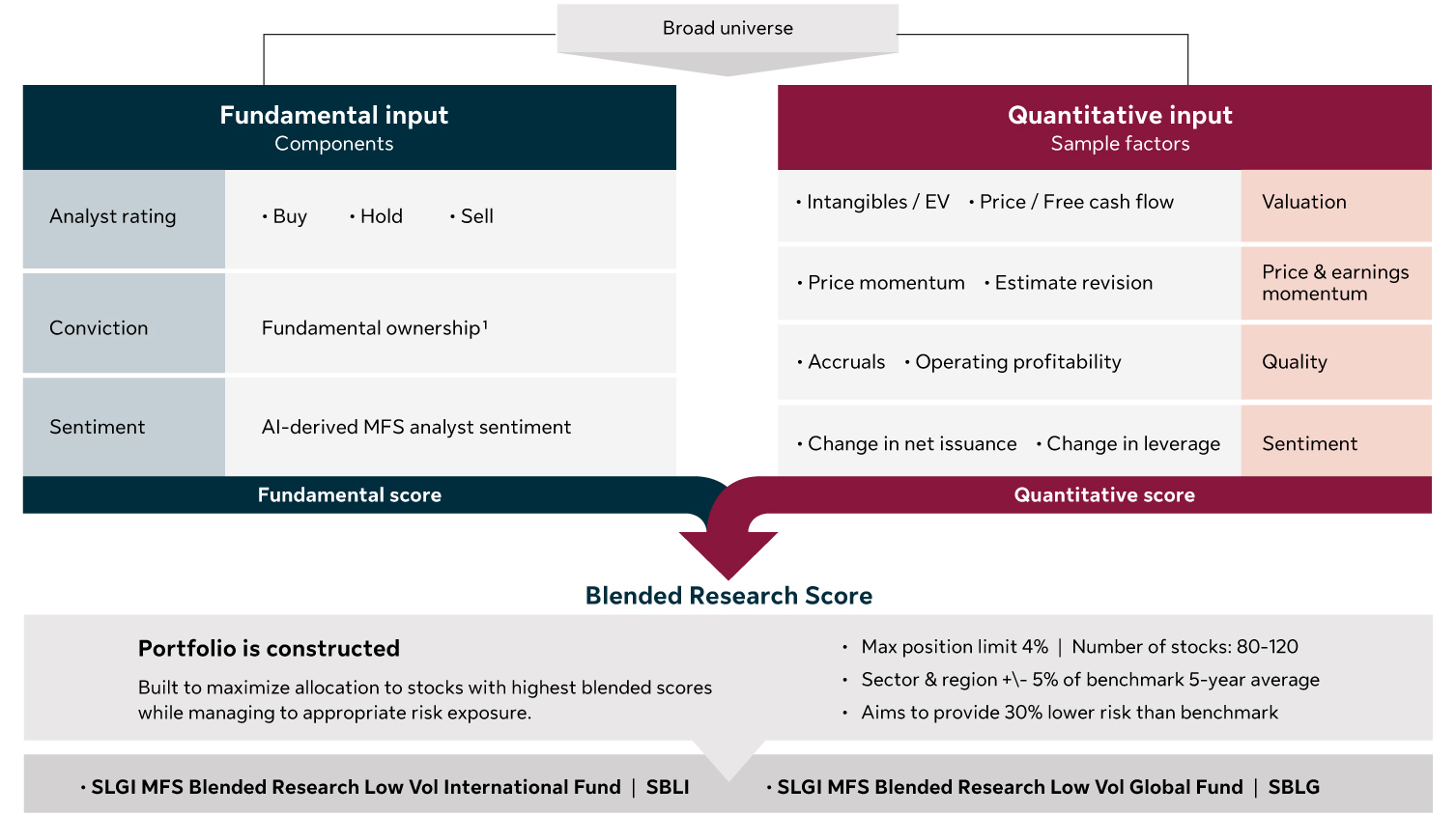
This example is for illustrative purposes only. No forecasts can be guaranteed.
1Whether the stock is held at an overnight versus benchmark in diversified fundamental equity portfolios, excluding sector portfolios and concentrated portfolios.
How does MFS’ Blended Research Low Volatility approach work in practice?
- Defines the universe through volatility screening: Within their Low Volatility suite of capabilities, MFS eliminates roughly 30% to 40% of the most volatile securities from consideration, aiming to reduce volatility while maintaining diversification and upside participation.
- Research inputs: Utilize a 50-50 blend of MFS’ proprietary fundamental and quantitative research to identify stocks with attractive attributes
- Portfolio constructed through optimization: Using advanced tools, MFS builds portfolios that balances Blended Research scores, sector & regional exposures, liquidity, and volatility constraints.
- Active risk management: Every decision is guided by an experienced portfolio manager and consistent with each fund’s investment objectives.
Why does this matter for investors?
- Greater confidence in decision making: The Blended Research approach combines two proven research methods to uncover opportunities others might overlook—helping you invest with conviction, while also remaining diversified.
- Risk-aware, growth-oriented: Designed to prioritize stability without sacrificing growth potential, this approach aims to keep the fund’s portfolio resilient in uncertain markets while participating in the upside potential during market rallies.
- Access to global expertise: Backed by over a century of active equity management and research teams in eight offices worldwide, leverages MFS’ full research capabilities to deliver disciplined, data-driven decisions.
- Stay invested through volatility: Low-volatility strategies may help reduce emotional decision-making and improve investor discipline during market downturns - critical for long-term success.
Trust in a proven process: Funds that bring MFS’ rigorous, research-driven approach can offer clarity and consistency even when markets are noisy and unpredictable.
Why choose SLGI MFS Blended Research Low Vol Funds?
- Global diversification: Accessing stable companies across developed and emerging markets can help reduce reliance on any single economy, unlocking more diversification across regions and industries.
- Risk-conscious design: These mandates may be appropriate for investors seeking equity exposure, without the full brunt of downward market swings.
- Institutional-quality research: Through SLGI’s relationship with MFS, investors gain access to strategies built on deep global insights and decades of experience.
Closing thoughts
Low volatility equity investing is not about eliminating risk – it’s about managing risk thoughtfully. Through the SLGI MFS Blended Research Low Vol Funds, investors gain access to strategies designed to help smooth out market swings, broaden their portfolio, and support long-term growth potential regardless of the road being traveled.
Now available in ETF Series.
Learn more about SLGI MFS Blended Research Low Vol International Fund
Learn more about SLGI MFS Blended Research Low Vol Global Fund
* Effective January 12, 2026, the Sun Life MFS Low Volatility Global Equity Fund was renamed SLGI MFS Blended Research Low Vol Global Fund, and the Sun Life MFS Low Volatility International Equity Fund was renamed SLGI MFS Blended Research Low Vol International Fund. Their investment objectives and strategies remain unchanged. Effective Feb. 1, 2026, their management fees were reduced.
This article is provided for information purposes only and is not intended to provide specific individual financial, investment, tax or legal advice. Views expressed regarding a particular company, security, industry or market sector should not be considered an indication of trading intent of any mutual funds managed by SLGI Asset Management Inc. These views are not to be considered as investment advice nor should they be considered a recommendation to buy or sell.