
Sun Life ETF+ Portfolios quarterly update
With bond yields rising in Q3, investors placed greater emphasis on earnings delivery over longer-term growth expectations.

What happened in the quarter?
Global markets faced a more complex backdrop in the third quarter (Q3) of 2026 as geopolitical tensions, renewed inflation concerns and changing monetary-policy expectations influenced performance across asset classes. Ongoing disruption in the Middle East and limited progress toward reopening the Strait of Hormuz kept energy prices elevated. This supported energy producers but increased cost pressures for transportation, industrial and consumer-oriented businesses.
Higher energy prices also contributed to a shift in interest rate policy. On September 16, the U.S. Federal Reserve raised its key interest rate by 25 basis points to a target range of 3.75%–4.00%, its first increase since 2023. Long-term government bond yields rose globally, including in Canada, creating a more challenging environment for fixed income and increasing valuation sensitivity for rate-sensitive equities.
Equities outperformed bonds over the quarter, supported by resilient earnings growth and investors’ continued risk appetite. Regional equity returns diverged, with U.S. equities outperforming on stronger earnings momentum and AI-related investments. Emerging markets and Japan also posted solid gains, while Europe lagged amid softer growth and weaker earnings trends.
Technology and AI-related companies continued to support market leadership through sustained investment and strong earnings expectations. Higher bond yields, however, increased differentiation between companies delivering current earnings and those relying more heavily on future growth expectations.
Canadian equity performance reflected its exposure to the financials, materials and energy sectors. Renewed U.S. tariffs and Canadian countermeasures weighed on industrials, exporters and companies with integrated North American supply chains. By quarter-end, relative performance among Canadian equities increasingly reflected their commodity exposure, earnings visibility, valuations, and sensitivity to interest rates and trade policy.
| Top contributors/detractors | |
|---|---|
+ Overweight exposure to health care and financials added value. |
- Underweight exposure to energy and information technology detracted value. |
What changes did we make?
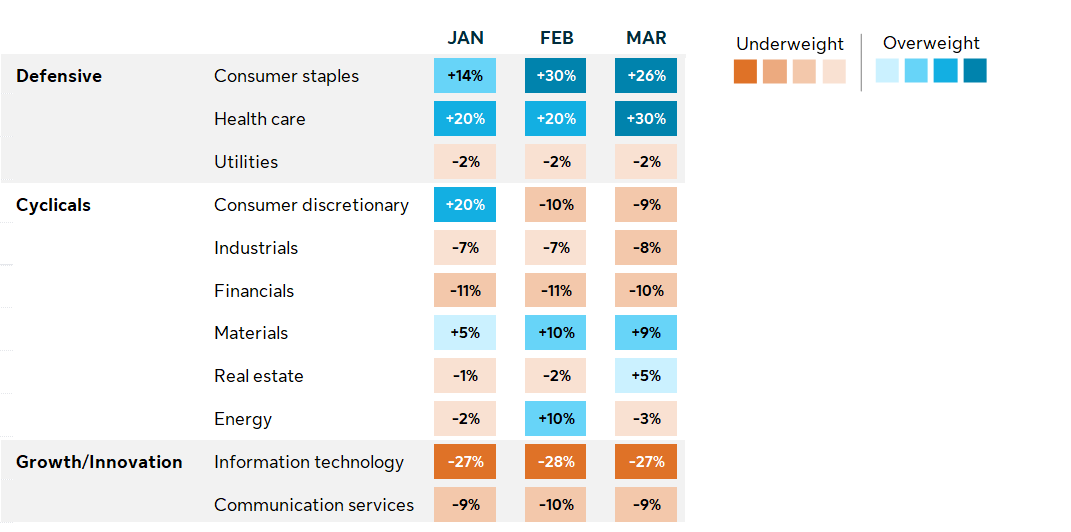
Throughout Q3, our U.S. sector rotation strategy maintained a defensive tilt as markets balanced resilient corporate earnings and continued AI-driven enthusiasm against rising bond yields, persistent inflation risks and elevated policy uncertainty. Consumer staples and health care remained core positions throughout the quarter, supported by their defensive characteristics, resilient earnings profiles and attractive valuations across our models. In July and August, we also held real estate and financials, providing exposure to rate-sensitive areas of the market as the model saw potential for growth based on macroeconomic conditions and improving performance.
During July and August, market leadership broadened beyond a narrow group of technology stocks, and our models identified improving opportunities in real asset-related sectors. This trend reversed sharply in September as leadership narrowed once again. As a result, we rotated out of real estate and financials in September and added materials, reflecting strengthening performance trends and attractive valuations. The change increased our exposure to commodity demand, infrastructure investment and energy transition spending while maintaining diversification across defensive, quality and cyclical sectors. Overall, portfolio changes during the quarter reflected our systematic approach of combining macroeconomic conditions, valuations and performance turnaround signals to identify sectors with the most attractive risk-adjusted opportunities.
Q3 sector heatmap – Our U.S. sector rotation strategy positioning at a glance
What’s next?
Heading into Q4 2026, markets face a mixed backdrop of resilient earnings, still-elevated valuations, steady economic activity and significant policy uncertainty. Our base case remains constructive, but more selective: we continue to favour equities, while emphasizing diversification across regions, sectors and investment styles rather than relying on further valuation expansion.
Corporate earnings remain supported by technology investment and generally stable economic activity. Market leadership broadened in July and August before narrowing again in September. With valuations above long-term averages, markets are increasingly sensitive to earnings expectations and economic data. Within equities, we favour companies with visible earnings, durable cash flows and credible returns on investment, particularly in AI.
Inflation has eased but remains influenced by energy prices, trade developments and geopolitical events, with higher energy costs potentially slowing progress toward central bank inflation targets. Against this backdrop, we expect monetary policy to remain restrictive, while long-term bond yields will likely continue to reflect inflation expectations, fiscal pressures and government borrowing needs. Although yields may remain volatile and haven’t necessarily peaked, in our view, higher starting yields have improved the return potential of high-quality bonds.
Based on our outlook, we enter Q4 with a defensive sector positioning, favouring areas of the market with resilient earnings, stable cash flows and less sensitivity to the economic cycle.
View fund performance (Series F)
| Sun Life ETF+ Portfolios advisor materials (log-in required): | Sun Life ETF+ Portfolios Investor material: |
|---|---|
Commissions, trailing commissions, management fees and expenses all may be associated with mutual fund investments. Please read the prospectus before investing. The indicated rates of return are the historical annual compounded total returns including changes in unit value and reinvestment of all dividends or distributions and do not take into account sales, redemption, distribution or optional charges or income taxes payable by any security holder that would have reduced returns. Mutual funds are not guaranteed, their values change frequently and past performance may not be repeated.
Views expressed regarding a particular company, security, industry or market sector should not be considered an indication of trading intent of any mutual funds managed by SLGI Asset Management Inc. These views are subject to change and are not to be considered as investment advice nor should they be considered a recommendation to buy or sell. This commentary is provided for information purposes only and is not intended to provide specific individual financial, investment, tax or legal advice. Information contained in this commentary has been compiled from sources believed to be reliable, but no representation or warranty, express or implied, is made with respect to its timeliness or accuracy.
Information contained in this commentary has been compiled from sources believed to be reliable, but no representation or warranty, express or implied, is made with respect to its timeliness or accuracy. Mutual funds transact daily, and the metrics presented may change at any time, without notice. This commentary may contain forward-looking statements about the economy, and markets; their future performance, strategies or prospects. The words “may,” “could,” “should,” “would,” “suspect,” “outlook,” “believe,” “plan,” “anticipate,” “estimate,” “expect,” “intend,” “forecast,” “objective” and similar expressions are intended to identify forward-looking statements. Forward-looking statements are not guarantees of future performance and are speculative in nature and cannot be relied upon. Forward-looking statements involve inherent risks and uncertainties about general economic factors, so it is possible that predictions, forecasts, projections and other forward-looking statements will not be achieved. You are cautioned to not place undue reliance on these statements as a number of important factors could cause actual events or results to differ materially from those expressed or implied in any forward-looking statement. Before making any investment decisions, you are encouraged consider these and other factors carefully.