
What is an ETF? A beginner’s guide to exchange-traded funds in Canada
Since making their debut in Canada in 1990, ETFs have surged in popularity – reaching over half a trillion dollars in assets by the end of 2024.

An ETF, or exchange-traded fund, is a type of investment fund that holds a basket of investments or securities – like stocks or bonds for example. When you buy shares of an ETF, you're buying a piece of that entire basket, and not just one company.
More and more Canadians are investing in ETFs, thanks to their flexibility, and the diversification they can offer through exposure to different markets, asset classes and investment strategies.
Canadian ETF assets have grown more than 7X in the past decade, says the 2024 SIMA Investment Funds Report.
Canadian ETF assets have grown 7X over the past decade1
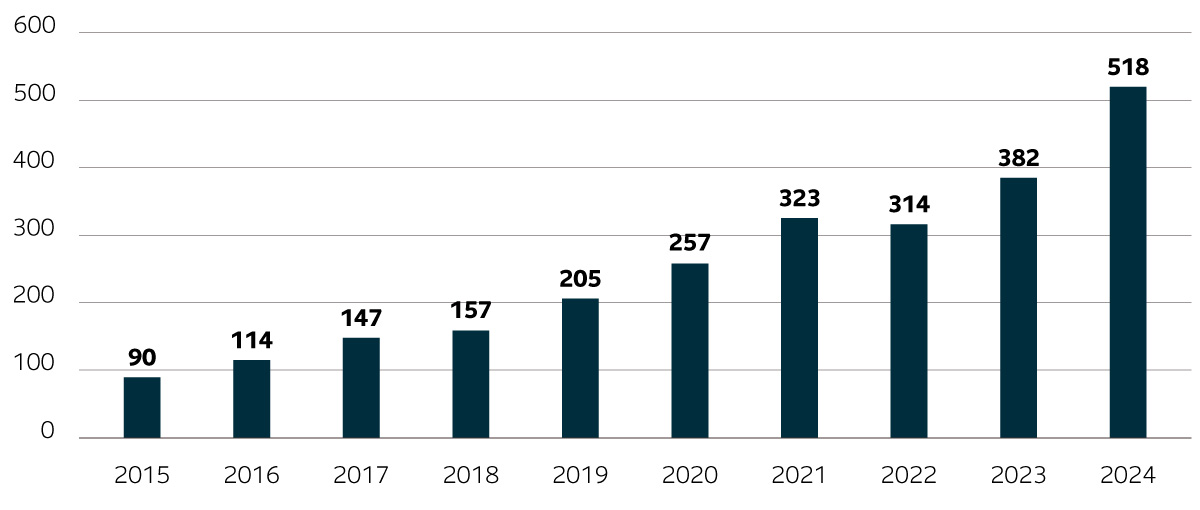
Source: SIMA 2024 Investment Funds Report1
What exactly are ETFs, and how do they work?
At their core, ETFs are investment vehicles that have similar features to both mutual funds and stocks. Created and managed by investment companies, ETFs consist of a basket of securities designed to track the performance of a specific market index, economic sector, commodity, or other underlying asset.
ETFs also exist that are actively managed by financial professionals and some managers even offer ETF Series of their mutual funds. To find out more about these, read our article ETF Series & mutual funds: a comparison.
Unlike mutual funds, ETFs trade on stock exchanges throughout the day with their share price varying, like individual stocks. “Real time trading” allows investors to buy and sell ETF shares at varying prices during trading hours.
ETFs are available for almost every conceivable sector, geographic region, or investment strategy. And they can invest in different types of financial products, such as:
- stocks;
- regardless of their size, sector, or region
- bonds;
- including government, corporate, or municipal
- commodities;
- such as gold, oil, and agricultural products
- real estate;
- like real estate investment trusts (REITs)
- currencies;
- derivative products;
- and many others.
Types of ETFs: Passive vs Active
An ETF is generally classified as either active or passive based on its objective and investment approach.
Passive ETFs usually aim to replicate the performance of a benchmark or index, such as the S&P 500, by closely tracking its composition and investing in the same securities as the index.
In contrast, active ETFs are actively managed by portfolio managers who aim to outperform a benchmark or index for the portfolio they manage. Actively managed ETFs may experience bigger performance fluctuations, but they can offer the potential for better than market returns compared to their passive counterparts.
Where and how to buy ETFs in Canada
Buying an ETF is very similar to buying a stock. Typically, you need to have a brokerage account. Every ETF has its own ticker symbol that you can use to buy or sell it on a stock exchange, like the Toronto Stock Exchange (TSX). Ways to buy and sell ETFs include working with your advisor or trading them in a direct investing account.
ETFs share characteristics with both mutual funds and stocks. Like these investment products, ETFs are not guaranteed investments. Similar to stocks, the value of an ETF fluctuates based on market conditions.
Key differences between stocks, mutual funds and ETFs
| Product |
Stocks |
Mutual funds |
ETFs |
|---|---|---|---|
|
Trade on a stock exchange |
Yes |
No | Yes |
|
Fixed distributions possible |
No |
Yes | Yes |
|
Intraday price valuation |
Yes |
No | Yes |
|
Use of different investment strategies |
No |
Yes | Yes |
Additional features of stand-alone ETFs
ETFs also offer some additional features that make them an increasingly popular investment product for Canadians:
- Instant diversification: In a single transaction, Canadians can invest in a diversified basket of securities.
- Flexibility: ETFs allow investors to gain exposure to a wide range of markets and assets. They come in a broad range of options, including as mutual funds options called ETF series.
- Lower management fees: Typically, traditional mutual funds have higher management fees than ETFs. However, because ETFs trade on a stock exchange, investors often pay brokerage fees to buy and sell these securities.
- Increased liquidity: As ETFs trade on a stock exchange like stocks, you can buy or sell them during the trading day at market prices.
Ask your financial advisor about ETFs and ETF Series
Financial advisors frequently use ETFs to enhance and diversify their clients' investment portfolios. ETFs may simplify the process of portfolio construction while allowing advisors to fine-tune exposure to various market risks. Lastly, ETFs are commonly thought of as being more tax efficient, as they generally result in fewer taxable distributions compared to mutual funds due to less trading activity.
This article is provided for information purposes only and is not intended to provide specific individual financial, investment, tax or legal advice. Views expressed regarding a particular company, security, industry or market sector should not be considered an indication of trading intent of any mutual funds managed by SLGI Asset Management Inc. These views are not to be considered as investment advice nor should they be considered a recommendation to buy or sell.
An ETF is a stand-alone investment fund, while an ETF series is an exchange-traded class of securities offered by a conventional mutual fund. Investors generally pay brokerage fees to their dealer if they purchase or sell units of an ETF or ETF series on a recognized Canadian stock exchange. Investors may pay more than the current net asset value when buying units of the ETF or ETF series and may receive less than the current asset value when selling them. Please read the prospectus and ETF Facts before investing.
Commissions, trailing commissions, management fees and expenses all may be associated with mutual fund and ETF investments. Please read the fund’s prospectus. Mutual funds and ETFs are not guaranteed, their values change frequently and past performance may not be repeated.