

Retirement should be a time to enjoy everything you’ve worked hard for – but rising costs can quietly undermine that dream. Discover the risks inflation can pose and strategies to help manage them.
How inflation impacts your investments
August 11, 2026
Inflation is top of mind for many of us. Not only does it impact our grocery bills, but it also affects our savings and investment income. Learn what inflation is, what causes it and how to protect your finances.

You've likely noticed that your dollar doesn't stretch as far as it once did. Everything costs more, and daily expenses seem to add up faster than ever. That’s inflation – or the steady increase in the cost of goods and services over time. Whether you're actively saving, investing or retired on a fixed income, inflation can pose a real threat to your financial security. But there are strategies that can help safeguard your investments.
Inflation – silently eroding your purchasing power
Simply put, the inflation rate is the pace at which the cost of goods and services increases over time. An increase in inflation can be caused by many things, including supply shortages and rising demand. Or it may be a sharp rise in production costs, including raw material and wages. These rising costs are often passed on to consumers. For example, when the price of oil rises there is an almost immediate increase at the gas pump.
To calculate Canada’s inflation rate, Statistics Canada created the Consumer Price Index (CPI). It assesses the cost of over 700 products every month, including food, clothing, housing and education. The components of the CPI constantly fluctuate. In the 40-year-period from April 1986 to April 2026, Canada’s average annual inflation rate was 2.41%.1 Or perhaps more aptly, as the Bank of Canada (BoC) puts it, the value of money fell by 2.41% annually.
This means, on average, something that costs $100 this year would cost $102.41 the next year. Sure, if you’re working, your wages may rise to keep pace with inflation. But if you’re retired and on a fixed income, your purchasing power (the amount of goods and services you can purchase) declines steadily over time.
Inflation and your purchasing power*
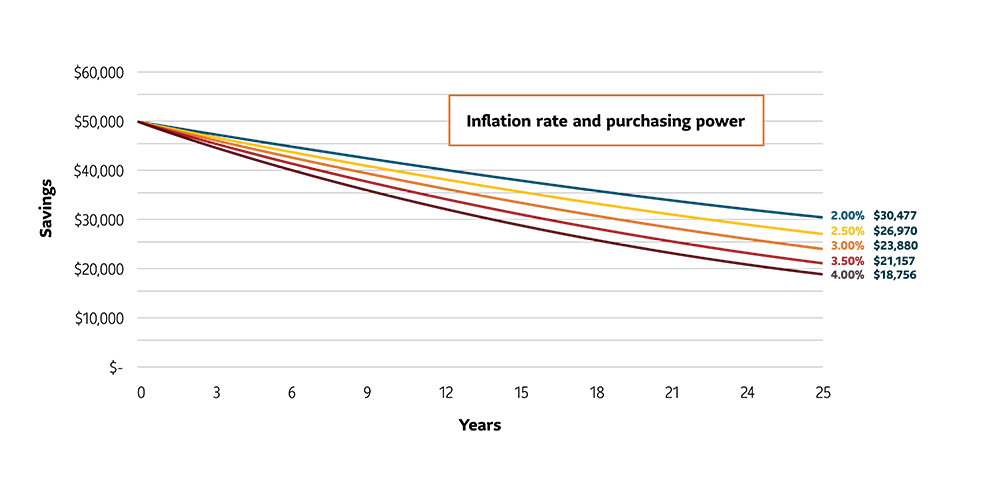
Source: Sun Life Global Investments. *Inflation rates used are hypothetical.
We’ve looked at how inflation erodes your purchasing power. But how will your investments hold up in an inflationary environment? It depends on what investments you’re holding.
Let’s start with bonds, and how they react to inflation. Among the most widely held bonds, are those issued by governments. These are high quality and backed by a low default rate. They’re called investment grade bonds and must carry a BBB credit rating or higher.
These bonds are owned for both the income they produce and their lower risk profile. This is why they’re often held by institutions, pension plans and investment managers to lower risk in their portfolios. For example, traditionally, to offset the risk inherent in equites, a typical balanced mutual fund or ETF would hold 40% in bonds and 60% in stocks.
Nevertheless, returns on bonds can be negatively affected by inflation in a couple of ways. First, depending on the interest rate, if you received an annual payment of $200 a year on your bond, you would be able to buy less and less each year with it. Secondly, these bonds can be hurt when interest rates rise. This may occur when inflation is running above the BoC’s 2% inflation target. To slow inflation, it could force the bank to raise its key lending rate.
It sounds counterintuitive, but when interest rates rise – bond prices fall. Bonds with longer maturity dates (such as a 20-year bond) are particularly vulnerable to rising rates. Why is this? Let’s say your 20-year, $10,000 bond comes with coupon rate of 5% (the coupon rate is the annual income you can expect to receive). The problem is if interest rates jump, new 20-year bond issues coming to market might have a higher coupon rate. If so, new buyers would obviously opt for the higher coupon. This in effect would reduce your bond's value with it now selling at a discounted price.
Alternatively, there are classes of bonds that are indexed to inflation. Two of the most widely held include floating rate bonds and treasury inflation-protected securities (TIPS).
Unlike most bonds that have a fixed interest rate, these types of bonds carry a variable coupon rate. For example, the interest rate on a floating rate bond is tied to a benchmark rate, such as the U.S. Federal Reserve’s (the Fed) key overnight rate. When the Fed rate rises, so will the interest paid on a floating rate bond.
Inflation and stock portfolios
Like bonds, the impact of inflation on your equity or stock holdings depends on how it is invested. Let’s begin by looking at dividend-paying stocks, a source of income for many investors. Dividends are usually paid on a quarterly basis, from a company’s cash flow or profits. And often range from 1% to 10%.
How are dividend payouts affected by inflation? Some companies, such as utility companies, may perform well in an inflationary environment because they can pass rising costs on to consumers. This allows them to increase their dividend payouts to investors. For example, if inflation is running at 3%, and a company increases its dividend to 5%, you could come out ahead.
The opposite would be true if rising costs triggered by inflation force a company to cut its dividend. So again, how inflation affects dividend income comes down to what dividend-paying stocks are included in a portfolio. That’s why managers who focus on dividends put great effort into analyzing a company before they invest. They want to determine whether the dividend being paid is sustainable and whether it may increase or decrease over time.
Inflation affects growth and value stocks differently
Growth and value investing are two common styles of investing. To understand why inflation affects these stocks differently, remember that inflation erodes the value of money over time. The important issue then is over what time frame is a company’s profitability being calculated. Or more succinctly: profits today could be worth more than potential inflation-eroded profits in the future.
Let’s begin with value stocks. By definition, these stocks trade at a discount to the market. However, when buying a value stock, the investment manager believes there is a reason that a company might return to, or increase, profitability. And the manager anticipates that this may occur over a comparatively short period of time.
With growth stocks, the opposite is often true. In this case, the investment manager may buy a well-known growth company that is forecasting profits well into the future. Or it may be a company with strong cash flows, even though it could be losing money or have low profits. The assumption being that it might be profitable at some point in the future.
As a result, when inflation and interest rates rise, growth stocks tend to fall. This is because the present value of future earnings is being discounted at a higher rate of inflation.
When inflation is low, growth stocks have historically outperformed value stocks. In periods of rising interest rates and inflation, value stocks may gain ground. In investing, however, past performance is not an indication or guarantee of future performance.
Inflation hedges: commodities and property
As we’ve noted, what’s held in a portfolio will go a long way to determining how it stands up to inflation. When inflation is rising, investment managers may invest in companies such as a utility. Or it could be a company manufacturing an essential product and that can pass rising costs on to consumers. They may also invest in specific asset classes, such as infrastructure and real assets, that have traditionally performed well in an inflationary environment.
Offsetting inflation requires a plan
We’ve shown how inflation can erode your purchasing power. But importantly, it’s what’s in a portfolio that matters when inflation increases. That’s why the best advice is to meet with an advisor. They have the ability assess your finances and suggest investments and strategies that may help offset the risk that inflation poses.
1 Source: Bank of Canada Inflation Calculator
Information contained in this article is provided for information purposes only and is not intended to provide specific financial, tax, insurance, investment, legal or accounting advice and should not be relied upon in that regard and does not constitute a specific offer to buy and/or sell securities. Views expressed regarding a particular company, security, industry, or market sector should not be considered an indication of trading intent of any mutual funds managed by SLGI Asset Management Inc. These views are subject to change and are not to be considered as investment advice nor should they be considered a recommendation to buy or sell. Please note, any future or forward-looking statements contained in this document are speculative in nature and cannot be relied upon. There is no guarantee that these events will occur or in the manner speculated. Information contained in this article has been compiled from sources believed to be reliable, but no representation or warranty, express or implied, is made with respect to its timeliness or accuracy.